
Little Rock, AR – October 21, 2026 – PRESSADVANTAGE –
Bale Collision Center has published consumer guidance explaining why the size of visible body damage alone does not determine how a damaged panel should be repaired. The October publication focuses on three common forms of collision damage, dents, creases, and cracks, and the different physical conditions each can create in an exterior component.
The guidance expands on Bale Collision Center’s auto body repair information by giving consumers a simpler framework for understanding repairability. Technicians can consider three primary factors: how the material has changed, where the damage is located, and what repair procedures apply to the affected component.
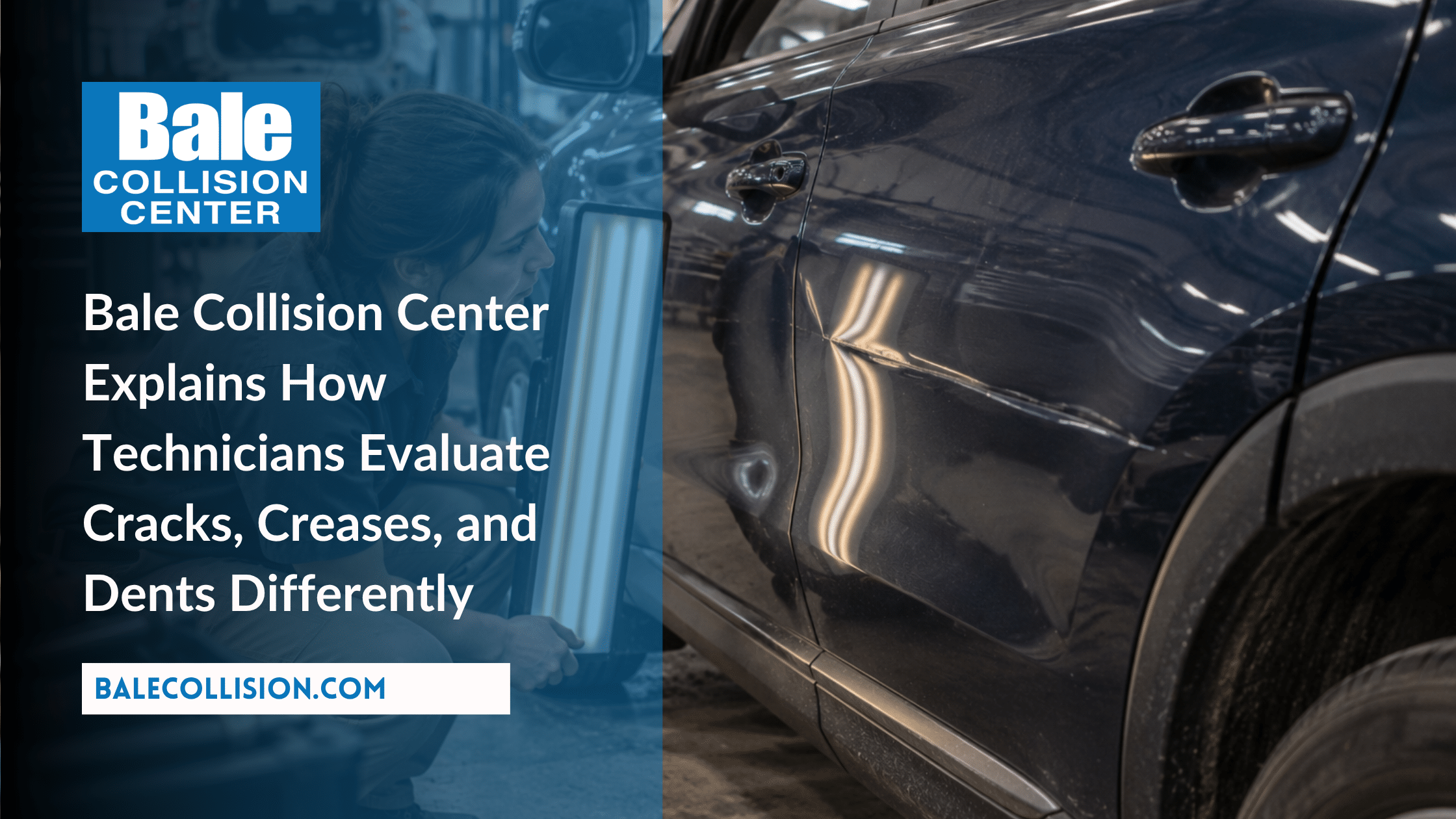
A dent generally involves material that has been displaced without separating. The repair approach can depend on the depth and shape of the dent, whether the material has stretched, and its location within the panel. A broad depression in an open section of a door can present different repair conditions from concentrated damage near an edge, reinforcement, or attachment area.
Body lines can also affect the assessment. Exterior panels are formed with contours that contribute to their shape and appearance. When a dent crosses one of these features, restoring the panel can involve different considerations from damage located on a relatively open surface.
For qualifying dents, paintless dent repair may provide a repair option when conditions such as paint integrity, damage shape, location, and accessibility allow the panel to be worked without conventional refinishing. Not every dent meets those conditions.
Creases represent a more concentrated deformation. Instead of a broad change in panel shape, collision force can create a defined line or fold. Evaluation can focus on the severity of that deformation, the condition of the material and coating, and whether the crease extends through an edge, body line, or other complex portion of the component.
This distinction helps explain why two damaged areas with similar dimensions can require different repair approaches. The measurement of a dent or crease provides only part of the information needed to assess the condition of the panel.
Cracks differ from both because the material has separated. They can occur in plastic bumper covers and other exterior components, while collision forces can also produce splits or tears in other materials.
Location becomes particularly important when a crack reaches a mounting tab, fastener area, edge, or another portion of the component involved in its installation or function. Technicians can evaluate the damaged material together with the role of the affected area before determining whether an applicable repair procedure exists.
The October guidance places particular emphasis on material identification because modern vehicle bodies can combine steel, high-strength steels, aluminum, plastics, and other substrates. These materials respond differently to impact and are not necessarily repaired using interchangeable techniques.
Manufacturer repair information can provide vehicle- and component-specific direction. Depending on the affected part, those procedures may establish requirements or limitations involving straightening, heating, sectioning, joining, or other repair operations. The applicable information therefore becomes another factor in determining repairability.
Paint condition can further distinguish otherwise similar damage. A dent with an intact finish may present different options from damage where the coating has cracked, chipped, or been removed. When collision damage exposes the underlying substrate, surface preparation, refinishing, and applicable corrosion-protection procedures can become part of the repair.
Damage also does not always fit neatly into one category. An impact can produce a dent containing a sharp crease, damage the paint at the point of contact, or deform a plastic component while creating a crack near its edge. In these cases, the complete condition of the component is evaluated rather than assigning the repair according to a single visible characteristic.
This is the central distinction introduced in the October publication. Instead of using damage size as the primary measure, the guidance separates assessment into material condition, damage location, and applicable repair procedures. Those factors help explain why a relatively large dent may sometimes remain repairable while smaller damage in a critical or restricted area can present different limitations.
The same framework also helps distinguish paintless dent repair, conventional body repair, and component replacement. The appropriate approach depends on the documented condition of the individual component rather than a predetermined rule based on diameter, length, or appearance alone.
Information about the facility and available repair services can be found through Bale Collision Center’s Chenal location resource. The Chenal facility serves vehicle owners from Little Rock and surrounding communities.
The October guidance provides consumers with a focused way to understand why repair recommendations can differ for damage that initially appears similar. Identifying whether material has been displaced, sharply deformed, or separated, and then considering its location and applicable repair information, gives repair planners a more complete basis for determining the appropriate approach.
Bale Collision Center is a family-owned collision repair business that has served the Little Rock community since 1952. The company provides collision repair, auto body repair, paintless dent repair, automotive paint services, glass replacement, and ADAS services through its two Little Rock locations. Its Chenal facility is located at 13101 Chenal Pkwy, Little Rock, AR 72211.
###
For more information about Bale Collision Center, contact the company here:
Bale Collision Center (Chenal)
Jason Spiller
(501) 221-7181
jspiller@baleautomotive.com
13101 Chenal Pkwy, Little Rock, AR 72211, United States


