Three specialist agents for math, circuits, and chemistry render figures as code and validate their own output; cumulative images surpass 3.8 million
SF, CA, UNITED STATES, July 28, 2026 /EINPresswire.com/ — Turing, a developer of reasoning-based AI agents, today announced a major update to GPAI Visuals, the visualization component of its STEM-focused AI agent GPAI. The update introduces an agentic generation method in which the AI writes each figure as code, renders it, verifies the output for errors, revises the code, and re-renders — repeating the loop until the figure meets accuracy requirements.
Conventional image generation models produce figures as pixels in a single pass. As a result, errors in elements where precision is essential — equations, coordinates, circuit connections, chemical bonds — cannot be identified or corrected by the model itself. GPAI Visuals addresses this limitation through a generate-render-verify-revise loop.
Three Specialist Agents Now Available
The update adds three domain-specific agents to GPAI Visuals:
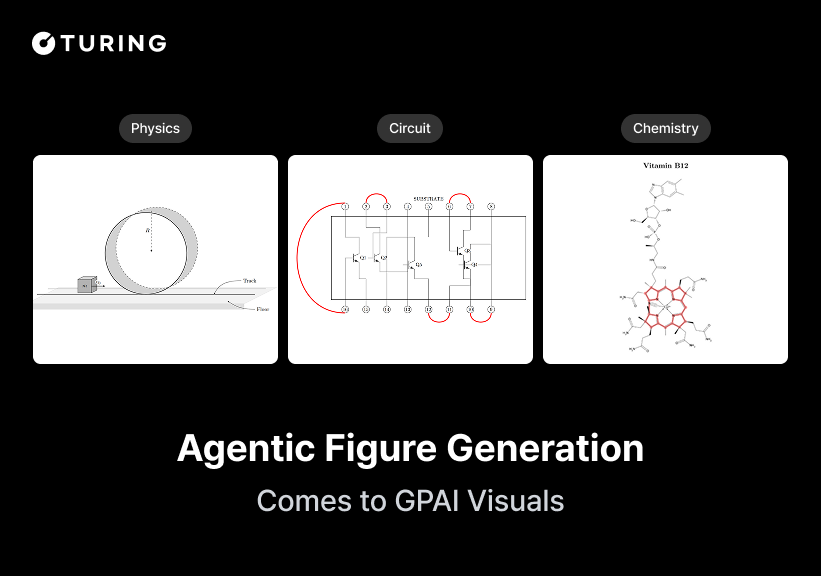
– TikZ Agent generates mathematics and physics diagrams, including geometric figures, coordinate systems, vectors, free-body diagrams, function plots, and tree structures. The agent converts natural-language requests into TikZ code, compiles the output, and revises the code when it detects overlapping elements or misplaced labels.
– CircuitikZ Agent generates electrical and electronic schematics, including RC, RL, and RLC circuits, filters, rectifiers, amplifiers, and op-amp designs. The agent constructs node topology in code using standard components such as resistors, capacitors, inductors, diodes, and transistors.
– Chemistry Agent generates molecular structures, including 2D structural formulas, organic compounds, functional groups, and ring and chain systems. The agent converts compound names or SMILES strings into structural data, renders them through a chemistry-specific renderer, and validates valence and bonding before finalizing the output.
Each agent executes the full loop autonomously: interpreting the request, generating code, rendering, verifying results, revising, and re-rendering. Unlike single-shot code generation, the agent reads rendered output back as input to determine its next action.
Code-Based Output Enables Reproducibility and Editing
Because a rendering engine executes the code deterministically, identical code produces identical results. Final outputs are delivered as vector and image files together with the underlying source code, allowing users to obtain precise figures without knowledge of TikZ syntax or chemistry drafting tools. Completed figures can be revised through natural-language requests, and the agent’s code generation, execution, and correction process is visible to users in real time.
According to Turing, the approach addresses limitations across three categories of existing STEM figure tools. General-purpose image AI produces raster output, which compromises label accuracy and connection integrity while preventing reproducibility. General-purpose LLM code generation is typically single-shot, resulting in frequent compilation failures and leaving verification to the user. Single-purpose tools such as TikZ generators and SMILES converters require domain expertise and do not accept natural-language input.
GPAI Visuals routes requests across mathematics, circuits, chemistry, data plots, and scientific illustration within a single interface. The platform is not tied to a single underlying model and selects the highest-performing model available for each task.
Adoption and Usage
Cumulative images generated on GPAI have surpassed 3.8 million, with per-user image generation increasing 10 percent following the update. A researcher at a U.S. AI laboratory reported reducing figure preparation time for research output from approximately three hours to ten minutes using GPAI Visuals.
GPAI is currently used at 415 universities in the United States, including MIT, Stanford, Harvard, and UC Berkeley.
Product Roadmap
Turing plans to continue improving the quality and editing capabilities of the three current agents while adding specialist agents across additional STEM domains that require dedicated notation and drafting conventions. A feature that converts generated figures and a user’s research context directly into presentation slides for lectures, seminars, and academic conferences is scheduled for release.
The company’s longer-term objective is an integrated environment that converts research content, experimental data, and references into precise, editable STEM figures and extends that output into papers and presentations. GPAI’s three core components — Problems, Visuals, and Chat — are being developed to support the full research workflow within a single environment.
“Figure preparation consumes a significant portion of a researcher’s time, and most AI tools produce output that appears correct without being accurate,” said Ji-eun Shin, co-CEO of Turing. “That output cannot be published. GPAI Visuals was built to close that gap.”
“What matters is that the output is code rather than pixels, which means it can be edited, reproduced, and verified,” said Jiyoon Kim, co-CEO of Turing. “Our goal is for GPAI to take research content and data directly to publication-grade figures.”
About Turing
Turing is a developer of reasoning-based AI agents focused on advancing education and research. Its flagship products include the AI math learning platform Math King and the STEM-focused AI agent GPAI. The company serves users in 123 countries — from K-12 and university students to graduate researchers, faculty, and corporate R&D teams. Turing’s research has been recognized at EMNLP 2025, where its work on LLM-generated math content was accepted to the industry track.
Team Cookie Official
Team Cookie
email us here
Visit us on social media:
LinkedIn
Facebook
Legal Disclaimer:
EIN Presswire provides this news content “as is” without warranty of any kind. We do not accept any responsibility or liability
for the accuracy, content, images, videos, licenses, completeness, legality, or reliability of the information contained in this
article. If you have any complaints or copyright issues related to this article, kindly contact the author above.

Media gallery