In the first quarter of 2026, the American Customer Satisfaction Index (ACSI®) fell 0.3% to a score of 76.7 (100-point scale) on an annual basis.
This press release features multimedia. View the full release here: https://www.businesswire.com/news/home/20260512244114/en/
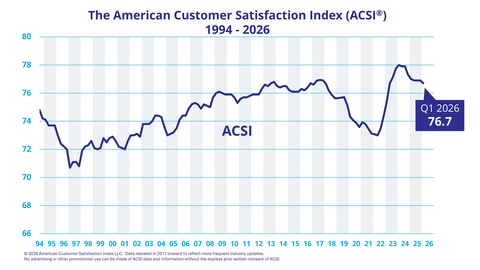
ACSI 1994-2026
After an upward drift during the first 13 years of this century, customer satisfaction became more volatile, but without directionality, during the next 13 years (through Q1 2026). The current national ACSI score is the same as it was in 2013. Around that time, the economy settled into a lower growth phase — decoupling changes in quality of economic output (ACSI) from quantity of economic output (GDP). Markets gradually became more concentrated, with sellers gaining market power. Equity markets became exceptionally concentrated, with negative repercussions for stock returns in consumer sectors relative to business-to-business, especially in technology. Measures of Customer Experience (Forrester) and Consumer Sentiment (University of Michigan) reached their lowest levels ever.
Estimates about how much has been invested to improve customer satisfaction/customer experience over the years vary, but it appears to be well over $100 billion annually with no detectable returns. If anything, the returns have been negative. Customer complaints have now reached record levels, surging by 16% in the first quarter. Paradoxically and contrary to what occurs in efficient markets, customer retention has increased. Accordingly, corporate profits soared. First quarter earnings were up by 15% — even more than the revenue increase. Most of the profit margin growth was in business-to-business, but many consumer-facing sectors also did well.
“When customers come back for more — even if they are less than satisfied — pent-up defection, the inverse of pent-up demand, intensifies,” said Claes Fornell, founder of the ACSI and the Distinguished Donald C. Cook Professor (Emeritus) of Business Administration at the University of Michigan. “When realized, the cost is the future revenue and profit lost, plus the additional expenditure for replacing departed customers. It is the flipside of the value escalation from customer retention growth — where loyal customers generate multiplicative, and at high levels of retention, exponential revenue growth. Profit improves even more than revenue because the marginal cost of keeping a customer is usually lower than the corresponding customer acquisition cost.”
Accordingly, the financial penalty for losing customers is extraordinarily high: Spirit Airlines, Sears, and JCPenney can testify to that. Reduced upsell opportunity, which also tends to encourage competitive inroads, is another causality associated with pent-up customer defection.
A customer’s ability to defect can be thwarted by various degrees of seller monopoly power and high customer switching costs. For companies in competitive markets, the probability of defection is minimized by making sure that customers are satisfied. Customer satisfaction- produced retention turns the dogma of “high risk/high return” into “low risk/high return.”
To get there, however, the currently used methods for strengthening customer relationships will not do: Analytics cannot be incompatible with the properties of customer data (extreme multicollinearity, non-normal frequency distributions, and high measurement error). The performance metrics must be profit relevant (unlike many now) and they should not produce more noise than signal — which is often the case today. They should be calibrated to maximize customer retention and deliver casual information on how to best allocate resources for it.
It is in customer retention where the financial return lies, and it is sizeable. Both economic growth and consumer utility would be beneficiaries, as would long-term profitability.
Claes Fornell, the Donald C. Cook Distinguished Professor of Business (Emeritus) at the University of Michigan, is the primary author of this press release. According to Google Scholar, Professor Fornell is the most cited person in the world on customer satisfaction and one of the most cited econometricians/statisticians with respect to structural equation models with unobservable variables and measurement error. He holds honorary doctorates from several universities.
For more, follow the American Customer Satisfaction Index on LinkedIn and X at @theACSI or visit www.theacsi.org.
No advertising or other promotional use can be made of the data and information in this release without the express prior written consent of ACSI LLC.
About the ACSI
The American Customer Satisfaction Index (ACSI®) is a national economic indicator and a leading provider of customer analytics products that help organizations build lasting customer relationships and prove ROI on experience investments. ACSI’s AI-enhanced platform delivers intuitive dashboards and cause-and-effect analytics that pinpoint the quality drivers most predictive of customer allegiance, retention, price tolerance, and financial performance. ACSI data has been shown to correlate strongly with key micro and macroeconomic indicators, including consumer spending, GDP growth, earnings, and stock returns.
Founded in 1994 at the University of Michigan’s Ross School of Business, the ACSI measures customer satisfaction with more than 400 companies in over 40 industries, including federal government services, based on approximately 200,000 annual interviews. Learn more at https://www.theacsi.org.
ACSI and its logo are Registered Marks of American Customer Satisfaction Index LLC.
View source version on businesswire.com: https://www.businesswire.com/news/home/20260512244114/en/
Media gallery