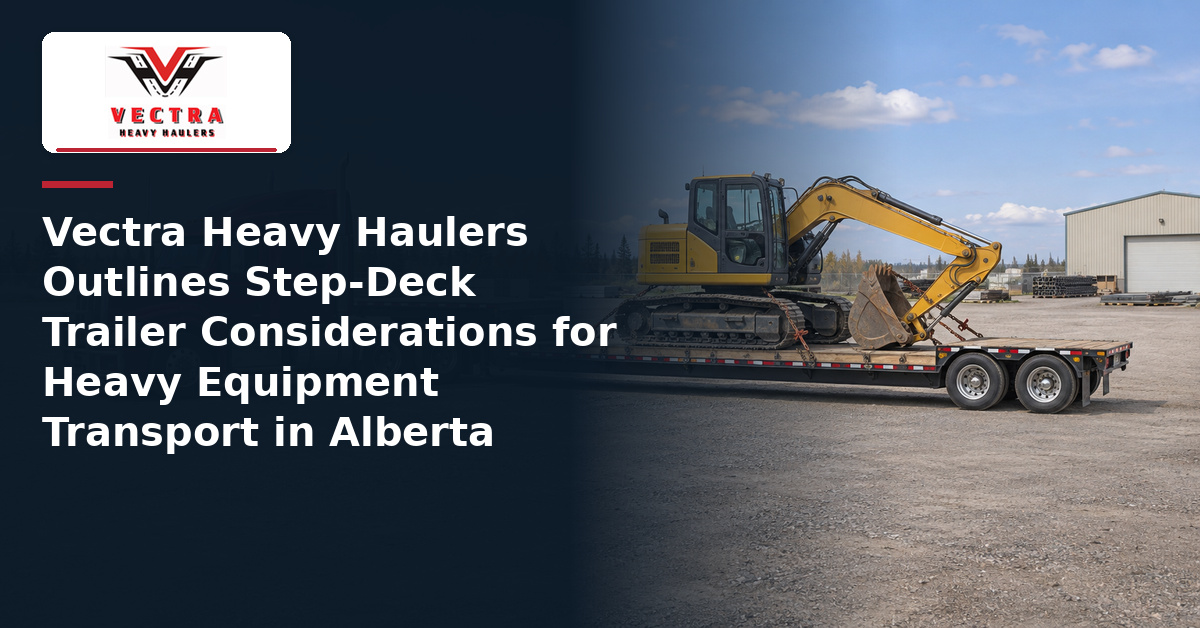
Heavy machinery shippers can reduce planning uncertainty by matching trailer configuration to load dimensions, weight, loading method and route constraints.
CALGARY, ALBERTA, CANADA, November 22, 2026 /EINPresswire.com/ — Vectra Heavy Haulers is outlining practical considerations for choosing a step-deck or other open-deck trailer when moving heavy equipment in Alberta. The freight-planning guidance focuses on the information needed before assigning a trailer: accurate cargo dimensions, total weight, securement needs, loading arrangements, route restrictions and destination access.
Step-deck equipment differs from a standard flatbed because its main deck sits lower than the front section. That lower deck can make it useful for certain taller loads, but the choice is not automatic. Shippers must also account for trailer axle configuration, cargo weight distribution, deck length and whether the equipment can be loaded safely at the pickup site.
A step deck trailer may be considered for industrial machinery, agricultural equipment or other irregular freight when the height available on a conventional flatbed is insufficient. The appropriate configuration depends on the exact unit, not just the equipment category. A low-profile step deck, an extendable version or another specialized trailer may be required for a load with unusual length or height.
The company advises shippers to record overall measurements in transport configuration. Detachable parts, tires, buckets, booms and protective structures can change those dimensions. Manufacturers’ published specifications are useful starting points but should be checked against the particular machine, attachments and condition before a truck is booked.
Weight also requires more than a single number. The combined weight of machinery, attachments and accessories matters, as does where that weight will rest on the trailer. Axle group limits, trailer capacity and legal road restrictions can affect feasibility. A trailer described as capable of carrying a particular load in one situation may not be lawful or appropriate on every route.
For heavy equipment transport, access at each end is a major planning factor. A machine may need ramps, a suitable loading dock, a crane or a different method of handling. The available turning space, ground bearing condition, surface slope and proximity of overhead obstructions should be considered before equipment arrives. Delays frequently begin when a vehicle reaches a site that cannot accommodate the planned loading method.
Route assessment is another essential step. Alberta road restrictions, bridges, construction zones and municipal rules can influence whether a shipment needs permits, escort vehicles or a revised path. Crossing into another province or the United States can introduce additional requirements. Dimensions that are legal in one jurisdiction should not be assumed acceptable in another.
Shippers comparing “Calgary trucking companies” for machinery moves can improve their initial inquiries by including the origin and destination, commodity, measurements, estimated weight, photos, lifting or driving capability and preferred delivery window. Providing clear information helps a carrier evaluate the equipment and approval requirements before a price or schedule is finalized.
Vectra Heavy Haulers publishes trailer-equipment guidance describing common flatbed, step-deck and double-drop configurations. Those descriptions are useful for understanding options but do not replace case-specific engineering, permit review or securement planning. Even similar machines can require different arrangements because attachments, loading equipment or site restrictions vary.
The company also emphasizes coordination among the shipper, transport provider, receiving site and any third parties responsible for cranes or escorts. Everyone should know who is preparing the load, who is providing access and what documents must be in place. Transport schedules should allow for permitted travel windows and site readiness rather than assuming a direct uninterrupted journey.
Documentation quality affects the planning process. Photographs from several angles can help clarify lifting points, overall shape and protruding attachments, but images do not replace measured dimensions. Equipment identification numbers, drawings and verified specifications can support discussion when unusual machinery or components must be moved.
Site contacts should also confirm whether the machine can be operated safely during loading. Non-running equipment may require winching, lifting machinery or other handling resources. The method needs to be understood before dispatch, since the wrong loading assumption can leave a suitable trailer unable to receive the cargo.
For time-sensitive projects, the proposed delivery date must be checked against authorization and route limitations. Permit processing, escorted travel, weather and site working hours can each affect when a shipment moves. A realistic schedule accounts for those variables rather than treating the distance alone as the final measure of transit time.
Summary
In conclusion, Vectra Heavy Haulers is encouraging businesses to treat trailer selection as an early project decision. Correct measurements, responsible weight assessment, appropriate loading arrangements and route planning can reduce avoidable uncertainty when moving specialized machinery across Alberta and beyond.
About Vectra Heavy Haulers
Vectra Heavy Haulers provides heavy-haul, open-deck, over-dimensional and freight transportation services in Canada and across North America. The company serves industrial and commercial shippers and publishes equipment and route-planning guidance to support specialized transport decisions.
Adam Gapinski
Vectra Heavy Haulers
+1 289-290-1033
info@vectraheavyhaulers.com
Visit us on social media:
LinkedIn
Instagram
Facebook
Vectra Heavy Haulers Outlines Step-Deck Trailer Considerations for Heavy Equipment Transport in Alberta
Legal Disclaimer:
EIN Presswire provides this news content “as is” without warranty of any kind. We do not accept any responsibility or liability
for the accuracy, content, images, videos, licenses, completeness, legality, or reliability of the information contained in this
article. If you have any complaints or copyright issues related to this article, kindly contact the author above.

Media gallery